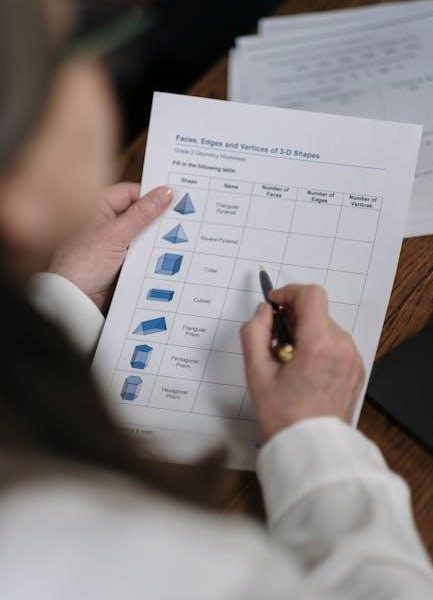
Law of Sines Worksheet PDF: A Comprehensive Plan
Kuta Software provides a readily available Law of Sines worksheet PDF, focusing on triangle problem-solving. These resources offer practice with finding missing angles, sides, and triangle areas.
The worksheets include problems requiring students to solve triangles given various combinations of angles and sides, including the ambiguous case scenarios.
These PDFs are excellent tools for reinforcing the Law of Sines concepts and developing proficiency in trigonometric calculations, with detailed solutions.
The Law of Sines is a fundamental trigonometric principle establishing a relationship between the sides of any triangle and the sines of its opposing angles. This powerful tool is particularly useful when dealing with non-right triangles, where traditional trigonometric ratios (SOH CAH TOA) aren’t directly applicable.
A Law of Sines worksheet PDF serves as an invaluable resource for students learning to apply this concept. These worksheets typically present a series of triangle problems where students are tasked with finding unknown side lengths or angle measures. The core formula, a/sin(A) = b/sin(B) = c/sin(C), is the key to unlocking these solutions.
Understanding the Law of Sines is crucial in fields like surveying, navigation, and engineering, where calculating distances and angles in triangles is commonplace. Worksheets provide targeted practice, building confidence and skill in utilizing this essential mathematical principle.
What is a Law of Sines Worksheet?
A Law of Sines worksheet PDF is a collection of practice problems designed to help students master the application of the Law of Sines in trigonometry. These worksheets, often provided by educational resources like Kuta Software, present various triangle scenarios requiring students to calculate missing angles or side lengths.
Typically, a worksheet will include problems where students are given different combinations of information – two angles and a side (AAS), two sides and an included angle (SAS), or two sides and a non-included angle (SSA). The SSA case often introduces the ambiguous case, requiring careful consideration.
These PDFs are valuable learning tools because they offer structured practice, allowing students to progressively build their understanding and problem-solving skills. They often include answer keys for self-assessment and reinforcement of concepts.
Understanding the Formula
The Law of Sines establishes a relationship between the sides of any triangle and the sines of its opposite angles. The formula is expressed as: a/sin(A) = b/sin(B) = c/sin(C), where ‘a’, ‘b’, and ‘c’ are the side lengths, and ‘A’, ‘B’, and ‘C’ are the corresponding opposite angles.
Law of Sines worksheet PDFs heavily rely on students’ ability to correctly apply this formula. Understanding that this proportion holds true for any triangle is crucial. Students must be comfortable converting between side lengths and angle measures using sine functions.
Worksheets often present problems requiring students to rearrange the formula to solve for unknown sides or angles. Proficiency in algebraic manipulation is therefore essential alongside a solid grasp of trigonometric ratios.
When to Use the Law of Sines
The Law of Sines is most effectively applied when solving triangles where you are given certain combinations of information; Specifically, it’s ideal when you know two angles and one side (AAS or ASA), or two sides and an angle opposite one of those sides (SSA – the ambiguous case).
Law of Sines worksheet PDFs are designed to provide practice in identifying these scenarios. If you have a right triangle and know one acute angle and a side, you could use the Law of Sines, but trigonometric ratios (SOH CAH TOA) are often simpler.
Avoid using the Law of Sines if you only know three sides (SSS) or two sides and the included angle (SAS); the Law of Cosines is more appropriate in those situations; Recognizing the correct conditions is key to efficient problem-solving.
Types of Problems on Law of Sines Worksheets
Law of Sines worksheet PDFs commonly feature a variety of problem types designed to test understanding of the concept. A core focus is solving triangles – determining all unknown angles and side lengths given partial information. These problems often present scenarios like knowing two angles and a side (AAS), or two sides and a non-included angle (SSA).
Another frequent type involves finding missing angles or side lengths when some measurements are already provided. A significant portion also addresses the ambiguous case (SSA), requiring students to identify if one, two, or zero triangles are possible.
Furthermore, many worksheets include applications involving calculating the area of a triangle using the Law of Sines, providing practical context for the trigonometric principles.
Finding Missing Angles
Law of Sines worksheet PDFs dedicate a substantial portion to problems focused on determining missing angles within triangles. These exercises typically provide two side lengths and an angle, or two angles and a side, prompting students to apply the Law of Sines to isolate and solve for the unknown angle.
The process involves setting up a proportion relating the sines of angles to the lengths of their opposite sides. Students must then utilize inverse sine functions (arcsin) to calculate the angle measure, ensuring answers are rounded to the specified degree of precision – often the nearest tenth.
Worksheets often include diagrams to visually represent the triangles, aiding in correct angle identification and setup of the Law of Sines equation.

Calculating Missing Side Lengths
Law of Sines worksheet PDFs heavily emphasize calculating unknown side lengths of triangles. These problems generally present two angles and a side, or two sides and an angle (excluding the ambiguous case initially). Students employ the Law of Sines to establish a proportion, relating the sines of known angles to their corresponding sides and the unknown side.
The core skill involves isolating the unknown side in the proportion and then performing the necessary multiplication to solve for its length. Accuracy is crucial, and students are typically instructed to round their final answers to a designated decimal place, commonly the nearest tenth.
These worksheets often include visual diagrams, assisting students in correctly identifying corresponding angles and sides within the triangle when applying the Law of Sines.
Ambiguous Case of the Law of Sines
Law of Sines worksheet PDFs dedicate significant attention to the “ambiguous case” – scenarios where two sides and a non-included angle (SSA) are provided. This situation can yield zero, one, or two possible triangles, demanding careful analysis.
Worksheets guide students to first calculate the possible angle opposite the given side using the Law of Sines. Crucially, they must then determine if a second possible angle exists by subtracting the calculated angle from 180 degrees. If this second angle is positive, two triangles are possible.
Students must then evaluate both potential angles to see if they create valid triangles (sum of angles equals 180 degrees). Kuta Software worksheets often include specific problems designed to test understanding of this complex concept, requiring students to state the number of possible solutions.
Solving Triangles with the Law of Sines
Law of Sines worksheet PDFs heavily emphasize applying the formula to completely “solve” triangles – meaning finding all missing sides and angles. These worksheets present problems categorized by the given information, streamlining the problem-solving process.
A common type involves being given two angles and a side (AAS). Students use the Law of Sines to find a second side, then calculate the third angle (180° ⎼ sum of known angles), and finally, the remaining side.
Kuta Software worksheets also feature SAS (two sides and the included angle) problems, requiring initial use of the Law of Sines to find another angle, followed by finding the remaining angles and sides. Mastering these techniques is crucial for success, and the worksheets provide ample practice.
Given Two Angles and a Side (AAS)
Law of Sines worksheet PDFs frequently present scenarios where students are given two angles and a non-included side (AAS). This is often considered the most straightforward application of the Law of Sines for solving triangles.
The process begins by utilizing the Law of Sines to determine the length of a side opposite one of the known angles. Once this second side is calculated, finding the third angle is simple – subtract the two known angles from 180°.
Finally, apply the Law of Sines again to calculate the length of the remaining side. Kuta Software worksheets provide numerous examples of these AAS problems, building confidence and skill. Careful attention to rounding and proper setup is key to accurate solutions.
Given Two Sides and an Angle (SSA) ⎼ The Ambiguous Case
Law of Sines worksheet PDFs dedicate significant attention to the SSA (Side-Side-Angle) scenario, notoriously known as the “ambiguous case.” Unlike AAS, providing two sides and a non-included angle doesn’t guarantee a unique triangle.
Depending on the side lengths and angle measure, zero, one, or two valid triangles can exist. Worksheets guide students through checking for this ambiguity by calculating the height of the triangle and comparing it to the given sides.
Kuta Software problems often require students to determine the number of possible solutions before fully solving for the missing angles and sides. Mastering this case demands careful consideration of sine’s properties and potential supplementary angles.
Given Two Sides and the Included Angle (SAS)
Law of Sines worksheet PDFs frequently feature problems presented in the SAS (Side-Angle-Side) format. This scenario, where two sides and the angle between them are known, offers a straightforward application of the Law of Sines.
Unlike the ambiguous SSA case, SAS generally yields a unique solution. Students utilize the Law of Sines to first find one of the remaining angles, then calculate the third angle using the triangle’s angle sum property.
Kuta Software worksheets emphasize a systematic approach: identify the knowns, apply the Law of Sines to find an angle, and then complete the triangle. These problems build confidence in applying the formula and interpreting results.
Area of a Triangle Using the Law of Sines
Law of Sines worksheet PDFs extend beyond solving triangles to include calculating their area. When SAS (Side-Angle-Side) information is provided, a direct area formula is often utilized, but the Law of Sines offers an alternative approach.
This method involves first using the Law of Sines to determine a missing side or angle, enabling the application of the standard area formula: Area = ½absinC. Worksheets from resources like Kuta Software demonstrate this process step-by-step.
Students practice identifying appropriate sides and angles, ensuring correct application of the sine function. Mastering this technique provides flexibility in calculating triangle areas when not all direct measurements are available;
Formula for Area Calculation
The core formula for calculating a triangle’s area using the Law of Sines is derived from the standard area formula, Area = ½absinC, where ‘a’ and ‘b’ are side lengths, and ‘C’ is the included angle. Law of Sines worksheet PDFs frequently emphasize this relationship.
However, if the included angle isn’t directly given, the Law of Sines is employed to find it. The formula itself remains constant, but its application requires prior calculation of the necessary angle using ratios of sides to sines of opposite angles.
Kuta Software worksheets often present problems requiring students to strategically select which sides and angles to use, ensuring accurate area determination. Understanding this formula is crucial for solving diverse triangle problems.
Applying the Formula to Worksheet Problems
Law of Sines worksheet PDFs, like those from Kuta Software, present a variety of scenarios requiring the area formula’s application. Students must first identify the known values – typically two sides and the included angle – or calculate the missing angle using the Law of Sines itself.
Problems often involve rounding answers to the nearest tenth, demanding careful attention to detail. Worksheets progressively increase in complexity, moving from straightforward applications to those requiring multiple steps and strategic thinking.
Successfully solving these problems hinges on correctly substituting values into Area = ½absinC and accurately employing trigonometric functions. Mastering this skill builds a strong foundation for more advanced geometric calculations.
Resources and Tools
For students utilizing a Law of Sines worksheet PDF, several resources enhance the learning experience. Kuta Software offers a vast library of free worksheets, categorized by difficulty and topic, providing ample practice opportunities.
Online Law of Sines calculators, readily available through a quick web search, serve as valuable tools for verifying solutions and understanding the step-by-step process. These calculators can handle various triangle configurations.
Furthermore, numerous websites provide step-by-step solution guides and video tutorials, offering detailed explanations of complex concepts. These resources are particularly helpful when tackling challenging problems or the ambiguous case.
Combining worksheets with these tools fosters a comprehensive understanding of the Law of Sines.
Kuta Software Worksheets
Kuta Software stands out as a premier provider of Law of Sines worksheet PDFs, offering a comprehensive range of practice materials. Their worksheets are meticulously designed to cover all facets of the Law of Sines, from basic applications to complex problem-solving scenarios.
These resources include problems focused on finding missing angles, calculating unknown side lengths, and navigating the ambiguous case, with varying levels of difficulty; Worksheets often feature detailed instructions and clear formatting.
A key benefit of Kuta Software is the inclusion of answer keys, enabling students to self-assess their understanding and identify areas for improvement. The PDFs are easily downloadable and printable, making them accessible for classroom or independent study.

They are a staple for trigonometry education.
Online Law of Sines Calculators

While Law of Sines worksheet PDFs provide valuable practice, numerous online Law of Sines calculators complement the learning process. These digital tools allow students to quickly verify their solutions and explore different triangle configurations.
Many calculators require users to input known angles and side lengths, then automatically compute the missing values. This instant feedback is beneficial for understanding the relationships defined by the Law of Sines.
Several websites offer these calculators alongside detailed explanations and step-by-step solutions, enhancing the educational experience. They can be particularly helpful when tackling complex or ambiguous cases. However, it’s crucial to remember that calculators should be used as a supplement to, not a replacement for, understanding the underlying principles and practicing with worksheets.
They aid in quick verification.
Step-by-Step Solution Guides
Alongside Law of Sines worksheet PDFs, accessing step-by-step solution guides is incredibly beneficial for students. These guides break down complex problems into manageable steps, illustrating the application of the Law of Sines in a clear and concise manner.
Many resources, including those accompanying Kuta Software worksheets, provide detailed explanations for each problem, showing how to set up the equations, perform the calculations, and interpret the results.
These guides are particularly helpful when students encounter difficulties with specific problem types, such as the ambiguous case. They allow learners to identify their mistakes and understand the correct approach. Utilizing these guides alongside practice worksheets fosters a deeper understanding of the Law of Sines and improves problem-solving skills, leading to greater confidence.
They are a great learning tool.
Common Mistakes to Avoid
When working with Law of Sines worksheet PDFs, several common errors can hinder accurate problem-solving. Incorrect angle measurements are frequent, stemming from misreading the diagram or calculation errors. Always double-check given angles and those calculated during intermediate steps.
Rounding errors can accumulate, especially in multi-step problems. Avoid rounding intermediate results; maintain full precision until the final answer. A significant pitfall is misinterpreting the ambiguous case, leading to incorrect numbers of possible triangles.
Carefully analyze the given information to determine if the SSA scenario yields one, two, or zero solutions. Students should also be mindful of correctly applying the Law of Sines formula and ensuring proper side-angle pairings. Consistent attention to these details will improve accuracy and understanding.
Incorrect Angle Measurements
A frequent source of errors when completing a Law of Sines worksheet PDF involves incorrect angle measurements. Students often misread angles directly from diagrams, particularly when dealing with obtuse or reflex angles. Ensure accurate protractor use or careful interpretation of angle markings.
Calculation mistakes during angle determination are also common. When using inverse trigonometric functions (sin-1, cos-1, tan-1), verify the calculator is in the correct degree or radian mode. Remember that inverse sine yields only angles in a specific quadrant, requiring adjustments for angles outside that range.
Furthermore, errors can occur when applying the angle sum property of triangles (angles must add up to 180°); Double-checking calculated angles against this property is crucial for identifying and correcting mistakes within the Law of Sines problems.
Rounding Errors
When working through a Law of Sines worksheet PDF, rounding errors can significantly impact the final answer’s accuracy. Premature rounding of intermediate calculations—like side lengths or angles—introduces inaccuracies that propagate through subsequent steps. It’s best practice to maintain full calculator precision until the very end of the problem.
The Law of Sines relies on a chain of calculations; even small rounding differences accumulate. For instance, rounding a side length to the nearest tenth might cause a noticeable discrepancy when used to calculate another angle.
To minimize these errors, store intermediate values in the calculator’s memory and only round the final answer to the specified degree of precision. Always review the instructions on the worksheet regarding the required rounding format.
Misinterpreting the Ambiguous Case
A common challenge on a Law of Sines worksheet PDF is the “ambiguous case” (SSA). This arises when given two sides and a non-included angle, potentially leading to zero, one, or two possible triangles. Students often incorrectly assume a unique solution exists.
Carefully analyze the given information. Determine if the height of the triangle (calculated from the given side and angle) is less than, equal to, or greater than the other given side. This dictates the number of solutions.
Worksheets often include problems specifically designed to test understanding of this case. Failing to consider both possible angles (acute and obtuse) that satisfy the sine value is a frequent error. Always sketch a diagram to visualize the potential triangle configurations before solving.